Sphatik, Clear Quartz and Glass: Understanding the Differences
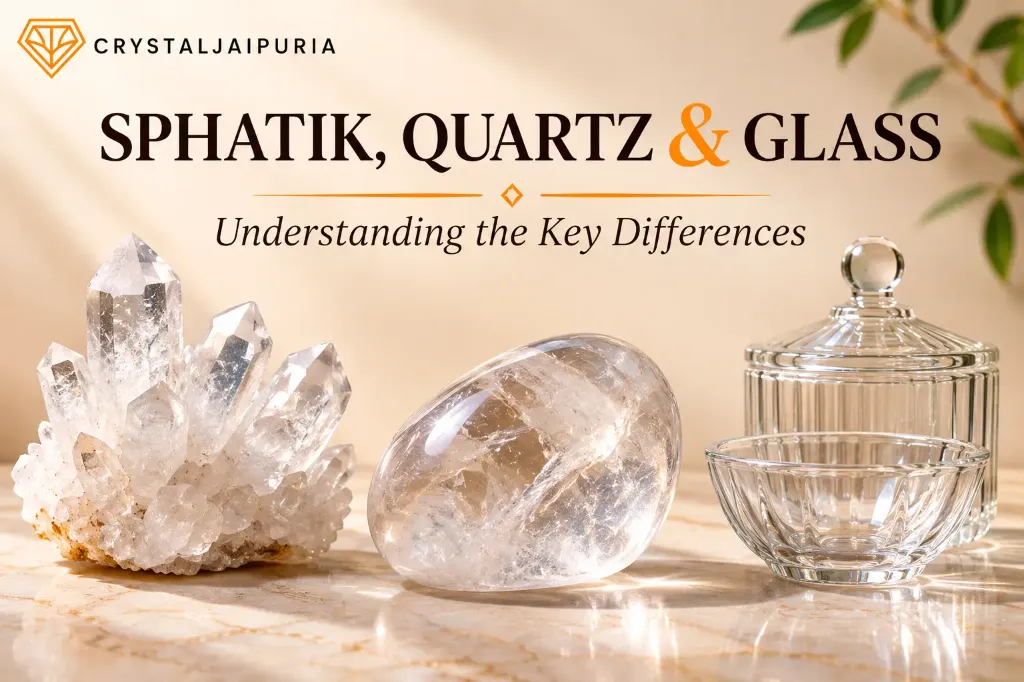
Sphatik, clear quartz and glass may look similar at first glance because all three can appear transparent, colourless and polished. However, they are fundamentally different materials with distinct chemical compositions, internal atomic structures and physical characteristics.
The key difference is that clear quartz is a naturally occurring mineral when it has formed geologically, while glass is an amorphous manufactured material. The term Sphatik is commonly used in Indian markets for transparent quartz, particularly in spiritual and decorative products. However, the exact material of an individual product should always be verified.
💎 Why Understanding Material Differences Matters
Understanding these differences helps buyers make informed decisions when purchasing crystal carvings, spiritual idols, and gemstone products. Visual transparency alone cannot establish authenticity—knowing how mineral formation, hardness, and internal inclusions work protects you from synthetic imitations.
1. What is Sphatik?
Sphatik is a traditional Indian term commonly associated with clear, transparent quartz used in spiritual, decorative and ornamental objects. In Vedic tradition and Sanskrit literature, Sphatik is revered as a pure, cooling mineral possessing positive vibrational energy.
From a mineralogical perspective, clear quartz is a crystalline variety of silicon dioxide (SiO₂). It forms naturally through geological processes deep within the Earth over hundreds of thousands of years and is widely used in jewellery, deity carvings, decorative objects and mineral collections.
Natural quartz can vary in transparency, internal structure and appearance. Some specimens are remarkably clear and flawless, while others contain visible natural inclusions, internal veil-like fractures, or cloudy areas.
In India, Sphatik is frequently associated with religious and spiritual objects, including sacred prayer malas (rosaries), decorative carvings, Sphatik Shivlings, and temple-related items.
However, it is important to understand that the word Sphatik alone does not establish the origin, purity or quality of a particular item. Because the term is used colloquially in retail markets, buyers should always confirm the exact mineral material, natural origin, and any treatments with the seller.
2. What is Clear Quartz?
Clear quartz is a transparent to translucent mineral variety belonging to the quartz species. Its chemical composition is silicon dioxide (SiO₂), and its regular trigonal crystalline structure fundamentally distinguishes it from ordinary glass.
Natural clear quartz forms under high-temperature hydrothermal and pegmatitic geological conditions over extended periods. In nature, it occurs as well-terminated individual prism crystals, dramatic crystal clusters, veins within host rock, and large massive boulders suitable for master lapidary carving.
Some commonly observed characteristics of clear quartz include:
- Transparent or translucent appearance: Allowing light to pass through with crisp refractive brilliance.
- Colourless body: Colorless to nearly colourless body without artificial tints.
- Natural crystal growth features: Hexagonal prism forms, striations, and growth twin planes.
- Natural internal features: Possible internal inclusions, delicate negative crystals, and wispy fractures.
- High Mohs hardness: A hardness of approximately 7 on the Mohs scale, making it significantly harder than glass and resistant to everyday scratching.
While quartz is relatively resistant to everyday scratches compared with softer materials, it possesses a conchoidal fracture pattern and can still chip or fracture under strong mechanical impact. Today, natural clear quartz is celebrated in high-end decorative sculptures, sacred temple idols, ornamental lapidary carvings, and fine jewellery.
3. What is Glass?
Glass is an amorphous solid, meaning it does not possess the regular, repeating, long-range crystalline lattice found in minerals such as quartz. Instead, its atomic structure resembles that of a supercooled liquid frozen in place.
Ordinary commercial glass is manufactured by melting silica sand (SiO₂) at high temperatures along with fluxing ingredients such as soda ash (sodium carbonate), lime (calcium oxide), and other chemical stabilizers that influence its melting point, refractive properties, and moldability.
Modern industrial manufacturing can produce glass in exceptionally transparent, bubble-free, coloured, or textured decorative forms. Because advanced casting techniques can create crystal-clear decorative objects with sharp facets, visual transparency alone cannot establish whether an item is quartz or glass.
Glass is frequently used in the gemstone trade to imitate natural crystals. While high-lead crystal glass or molded glass figurines may look visually appealing and sparkling, they lack the geological origin, physical durability, thermal properties, and sacred resonance of natural quartz specimens.
4. Sphatik vs Clear Quartz vs Glass: Key Differences
To help you quickly compare these three materials side by side, review the essential distinctions across origin, mineral structure, hardness, and internal characteristics:
| Characteristic | Sphatik | Clear Quartz | Ordinary Glass |
|---|---|---|---|
| Meaning | Traditional / commercial Indian term commonly used for clear quartz |
Mineral Variety
Naturally crystallized silica
|
Manufactured
Amorphous solid material
|
| Composition | Usually represented as quartz; verify the actual individual item | Silicon dioxide (SiO₂) | Silica-based melt with soda ash, lime, and flux additives |
| Structure | Depends on actual material (crystalline if authentic) |
Crystalline
Ordered 3D trigonal lattice
|
Amorphous
Random non-crystalline network
|
| Appearance | Transparent to translucent with soft optical clarity | Transparent to translucent with distinct double refraction | Can be exceptionally transparent, glass-like high surface gloss |
| Inclusions | May show natural internal veils, wisps, and fractures | Natural crystal veils, 2-phase fluid bubbles, growth zoning | Spherical gas bubbles, cooling swirl lines, or sterile clarity |
| Hardness | Depends on material; natural quartz is ~7 Mohs |
7 Mohs Scale
Scratches glass & steel knife
|
5 – 5.5 Mohs
Softer; easily scratched by quartz
|
| Origin | Verify Each Item |
100% Geological
Mined from earth deposits
|
Factory Manufactured
Molded or cast in furnaces
|
* Note: The table provides general distinctions for commercial reference. It should not be used as a substitute for professional laboratory gemological testing.
5. How Can You Distinguish Quartz from Glass?
Accurately identifying quartz and distinguishing it from imitation glass requires looking deeper than surface shine and transparency. Gemologists rely on several diagnostic physical and optical characteristics:
A. Internal Features & Inclusions
Natural quartz frequently contains unique geological fingerprints formed during crystallization. These include delicate veil-like fractures, tiny two-phase fluid inclusions (liquid and gas bubbles trapped inside), needle-like rutile or tourmaline fibers, and subtle cloudy zoning.
Manufactured glass, on the other hand, frequently contains spherical gas bubbles formed during the melting and cooling process, curved flow striae (swirl marks), or mold seams from casting. However, clean optical glass may lack bubbles entirely, while high-clarity quartz can be almost free of inclusions, so microscopic inspection is recommended.
B. Crystal Structure & Polariscopic Reaction
Because quartz is a crystalline mineral, it is anisotropic (doubly refractive). When examined under a gemological polariscope or crossed polarizing filters, quartz will display light and dark blinking as it is rotated, often revealing a classic "bull's eye" optic figure in convergent light.
Ordinary glass is isotropic (singly refractive) and will remain dark through 360-degree rotation, or show irregular snake-like anomalous double refraction (ADR) caused by internal manufacturing strain.
C. Mohs Hardness & Scratch Resistance
Natural quartz possesses a hardness of approximately 7 on the Mohs scale. Most window glass, bottle glass, and decorative glassware rate between 5.0 and 5.5 Mohs. This means quartz will readily scratch ordinary glass, while a steel knife blade (hardness ~5.5) will not scratch quartz.
D. Thermal Conductivity (Cold Touch)
Natural quartz conducts heat away from the skin much faster than glass. When you touch genuine natural Sphatik to your lips or forehead, it feels distinctively cold to the touch and takes longer to warm up. Glass feels comparatively neutral or warms up almost immediately.
E. Professional Gemological Testing
Certified gemologists employ non-destructive instruments—including refractometers (measuring quartz's 1.544–1.553 refractive index and +0.009 birefringence), specific gravity hydrostatic balances (~2.65 SG), and gemological microscopes. For significant investments or temple installations, independent gemological testing provides conclusive verification.
6. Why Does Material Identification Matter When Buying Sphatik Products?
Accurate material disclosure ensures buyers receive authentic value and that product claims match reality. A transparent decorative carving may look identical in online photographs, but a cast-glass piece manufactured in minutes has negligible intrinsic value compared to a hand-carved natural crystal sculpture.
Before finalizing a purchase, always ask the supplier:
- Exact Material: Is this item 100% natural earth-mined quartz, synthetic quartz, or manufactured glass?
- Treatments: Has the crystal undergone any clarity enhancement, heat treatment, or glass filling?
- Natural Inclusions: Are natural veil patterns or crystal zoning visible upon close inspection?
- Physical Specifications: Are precise weight (in grams/kg) and dimensions (in inches/cm) provided?
- Independent Documentation: Does the carving come with an authentic gemological laboratory test certificate?
For wholesale dealers and temple committees, insisting on clear material specifications in purchase orders ensures consistent quality across bulk deliveries.
7. What Should You Consider When Selecting Clear Quartz Carvings?
Choosing the right natural crystal idol depends on your personal spiritual practice, interior aesthetic, and budget. When evaluating fine clear quartz sculptures, keep these key criteria in mind:
- Transparency Grade: Decide whether you prefer water-clear gem grade, translucent soothing crystal, or character-rich naturally included quartz.
- Natural Veiling: Understand that subtle wisps, feather inclusions, and rainbow reflections are hallmarks of natural earth crystallization, not structural defects.
- Carving Proportions & Shilpa Shastra: Inspect facial symmetry, hand mudras, and precision polishing as per authentic Vedic sculpting traditions.
- Verified Dimensions: Review millimeter and inch specifications to gauge physical presence rather than relying solely on photo scales.
- Material Certification: Ensure the seller offers verifiable authenticity documentation confirming natural quartz origin.
Explore Handcrafted Crystal Carvings from Jaipur
At Crystal Jaipuria, every idol is sculpted from certified earth-mined quartz by traditional Jaipur lapidary masters. Explore our authentic collections to review detailed product dimensions, weight specifications, and laboratory certifications:
Conclusion
While Sphatik, clear quartz and glass can appear remarkably similar on display, their geological origins, crystalline structures, physical durability, and vibrational heritage are entirely distinct.
When acquiring transparent gemstone carvings for worship, home sanctums, or collectors' galleries, focus on verifiable material disclosure, master lapidary finishing, accurate physical measurements, and reputable laboratory documentation rather than visual appearance alone.
Frequently Asked Questions
1. Is Sphatik the same as clear quartz?
Sphatik is commonly used in India to refer to clear quartz. However, buyers should verify the actual material of a particular product instead of relying on its commercial name alone.
2. Is quartz better than glass?
They are different materials with different properties. Quartz is a crystalline mineral, whereas ordinary glass is an amorphous manufactured material. Which is suitable depends on the intended application.
3. Does natural quartz always have inclusions?
No. Some natural quartz specimens are very clear, while others contain inclusions, fractures or cloudy areas.
4. Can quartz be identified by scratching it?
A scratch test is not recommended. It can damage the product and is not a reliable standalone identification method.
5. What is the hardness of clear quartz?
Clear quartz has a hardness of approximately 7 on the Mohs scale.
6. Can glass look like natural quartz?
Yes. High-quality glass can be highly transparent and may visually resemble quartz. Professional testing may be needed to distinguish them.