Natural Gemstones vs Synthetic Stones: Key Differences and Buying Guide
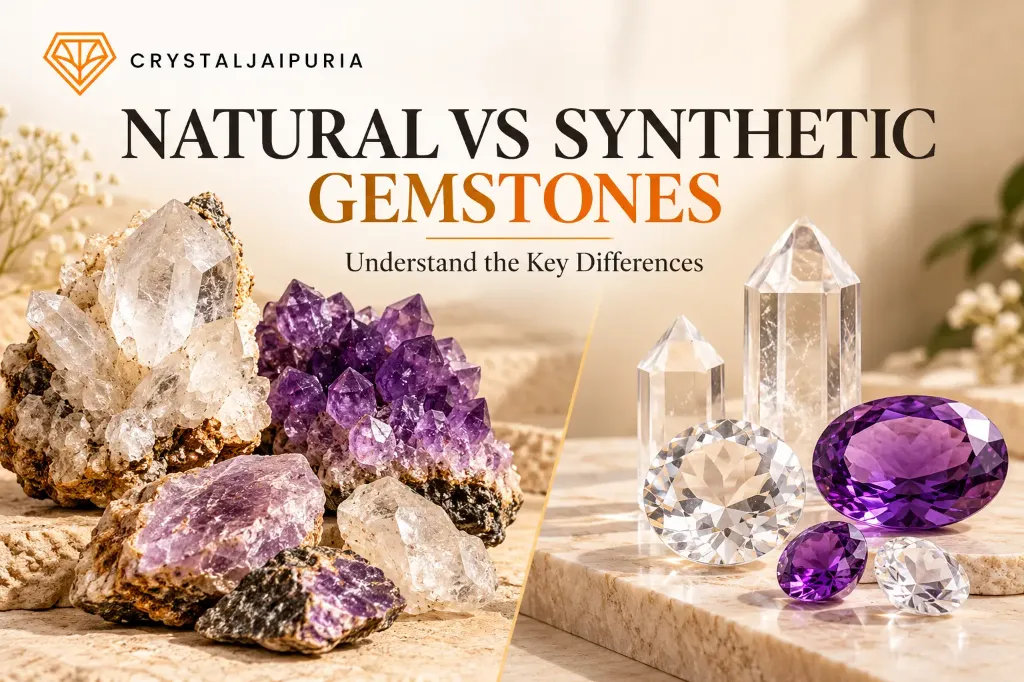
Whether you are acquiring an exquisite hand-carved deity idol, investing in fine gemstone jewelry, or selecting a crystal for Vedic Vastu harmonization, understanding the distinction between natural earth-mined gemstones and synthetic laboratory-grown stones is essential. While both may appear strikingly vibrant on the surface, their geological origins, internal growth signatures, energetic properties, and market valuations differ fundamentally.
💎 Quick Summary for Gemstone Carving Buyers
Synthetic gemstones share the same chemical formula as natural stones but are created in weeks in industrial autoclaves. For sacred carvings like Sphatik Shivlings and Gemstone God Statues, natural origin and transparent material disclosure are paramount to guarantee authentic Vedic energy and enduring craftsmanship value.
1. Understanding Natural Gemstones: Formation, Inclusions & Geological Signatures
Natural gemstones are geological treasures formed deep within the Earth's crust and upper mantle over millions—and in some cases billions—of years. Intense tectonic pressures, volcanic hydrothermal activity, and cooling magma cause mineral crystals such as Quartz (SiO₂), Corundum (Al₂O₃), Beryl, and Tourmaline to crystallize under extraordinary temperatures.
Natural Inclusions: Nature’s Unique Fingerprint
Unlike industrially manufactured materials, natural stones are almost never flawless. During their protracted geological formation, micro-crystals of neighboring minerals, minute liquid and gas veils (known as two-phase and three-phase inclusions), and color zoning planes become naturally trapped within the crystal matrix.
- Internal Veils & Feather Wisps: Distinctive internal textures typical of natural Sphatik (Quartz) and natural Rose Quartz.
- Rutile Needles & Mineral Platelets: Fine titanium rutile needles (as seen in star quartz and rutilated gemstones) confirming subterranean crystal growth.
- Color Zoning: Subtle, angular bands of varying color concentration that align with natural crystal growth faces.
Why Natural Crystals Hold Astrological & Vedic Value
In traditional Indian Vedic philosophy and the Brihat Samhita, natural gemstones act as cosmic transducers. Having spent eons absorbing geomagnetic and planetary radiation, authentic natural stones are believed to hold innate prana (vital life energy). This makes them indispensable for temple consecration, sacred murtis, and personal Vastu remedies.
2. What Are Synthetic Gemstones? Lab Synthesis & Artificial Crystals
A synthetic gemstone is an artificial crystal grown in a controlled laboratory environment. Crucially, a true synthetic stone has the identical chemical composition, crystal system, refractive index, and physical hardness as its natural counterpart.
Common laboratory synthesis methods include:
- Hydrothermal Growth: High-pressure, high-temperature autoclaves mimicking subterranean geothermal vents to grow quartz, emerald, and beryl crystals over weeks.
- Flame Fusion (Verneuil Method): Melting powdered alumina or silica through a high-heat oxyhydrogen flame to produce cylindrical boules of corundum and spinel.
- Flux Growth: Dissolving gem components in a molten chemical flux at lower temperatures to precipitate synthetic crystals with flux-fingerprint inclusions.
Synthetic Gemstones vs. Simulants (Imitations)
It is vital not to confuse synthetic stones with gemstone simulants (such as ordinary colored glass, cubic zirconia, or acrylic resin). Simulants merely imitate the visual appearance of a gemstone but possess completely different chemical formulas, softer hardness, and different physical densities.
3. Natural vs Synthetic Gemstones: Side-by-Side Comparison Matrix
The following comparison matrix outlines the pivotal distinctions every collector, worshiper, and jeweler should review:
| Key Parameter | Natural Gemstones | Synthetic / Lab-Grown Stones |
|---|---|---|
| Origin & Growth Time | Millions of years inside the Earth's crust | 2 to 12 weeks in laboratory autoclaves |
| Chemical Composition | Authentic mineral lattice with trace earth elements | Identical chemical formula, highly purified components |
| Internal Inclusions | Natural liquid veils, crystal needles, growth zoning | Uniform clarity, curved growth striae, flux remnants |
| Thermal Sensation | Noticeably cold to the touch; dissipates heat fast | Similar initial touch, but synthetic glasses warm rapidly |
| Vedic & Astrological Energy | 100% active; channels planetary prana and cosmic rays | Considered spiritually inert for Vedic idol energization |
| Rarity & Supply | Finite, depleted earth reserves; appreciating rarity | Virtually infinite factory production capacity |
| Best Application | Sacred deity idols, fine heirloom jewelry, Vastu remedies | Fashion accessories, costume jewelry, industrial lasers |
4. How to Identify Natural vs Synthetic Gemstones: Practical Inspection & Testing
Because advanced synthetic crystals mimic the density and optical index of natural stones, reliable identification requires combining sensory observation with professional gemological verification.
1. The Tactile & Temperature Test (The "Cold Touch")
Natural quartz and crystalline gemstones possess high thermal inertia. When you touch an authentic Sphatik Quartz statue or Shivling against your cheek or wrist, it feels instantly cold and takes several seconds to absorb body heat. Glass imitations warm up almost instantly.
2. Optical & Loupe Examination (10x to 40x Magnification)
Under a standard 10x jeweler's loupe:
- Natural stones: Reveal angular inclusions, mineral crystals, negative crystals, and straight growth banding.
- Synthetic stones: Often exhibit curved growth striae (in flame fusion corundum), spherical gas bubbles, or hexagonal seed plate shadows from the autoclave seed crystal.
3. Professional Gemological Laboratory Testing
For definitive confirmation, certified gemological laboratories use advanced non-destructive spectroscopy:
- Refractometer (RI): Measures the exact refraction angle of light through the crystal lattice.
- Polariscope: Differentiates singly refractive isotropic minerals from doubly refractive anisotropic crystals.
- FTIR (Fourier Transform Infrared Spectroscopy): Distinguishes natural quartz absorption bands from synthetic hydrothermally grown quartz with absolute scientific certainty.
5. Gemstone Carvings & Statues: What to Check Before Buying
Carving sacred sculptures—such as Ganesha Idols, Radha Krishna statues, and Sphatik Shivlings—requires exceptional artisanal skill. When purchasing gemstone carvings, consider the following critical guidelines:
Material Transparency & Ethical Disclosure
A reputable supplier must clearly declare whether a carving is crafted from 100% natural earth-mined stone, treated mineral, or synthetic crystal. There is nothing wrong with synthetic stones when sold with full disclosure, but misrepresenting lab-grown materials as natural sacred murtis violates buyer trust.
Artisanal Workmanship & Shilpa Shastra Proportions
In traditional Jaipur lapidary art, master artisans carve each idol by hand according to ancient Shilpa Shastra canons. Notice the delicacy of facial expressions (saumya bhava), smooth anatomical contours, and the hand-polished finish. Hand-carving on natural rough stones requires master precision, as natural inclusions must be skillfully navigated without fracturing the crystal.
📋 Key Questions to Ask Your Gemstone Carving Supplier:
Always ask about the exact material, whether it is of natural or synthetic origin, any known color or clarity treatments, precise dimensions and weight, independent gemological documentation, secure packaging protocols, and clear return terms.
Conclusion
Natural and synthetic gemstones differ primarily in how they form, not simply in how they look. Understanding their origin, examining the available documentation and asking precise questions can help buyers make better decisions.
When purchasing gemstone carvings, prioritise transparent material disclosure, appropriate verification and craftsmanship. These factors provide a more dependable basis for evaluating a product than appearance alone.
Frequently Asked Questions
1. Are natural gemstones always more expensive than synthetic stones?
No. Price depends on material, quality, rarity, size, workmanship, treatments and market demand. Natural origin alone does not determine value.
2. What should I ask a gemstone carving supplier?
Ask about the exact material, natural or synthetic origin, known treatments, dimensions, documentation, packaging and return terms.
3. Can synthetic gemstones be differentiated from natural gemstones with the naked eye?
In many cases, high-grade synthetic gemstones possess identical chemical composition, crystal structure, and refractive indices, making naked-eye identification virtually impossible even for experienced buyers. Differentiating them requires magnification (10x loupe or microscope) to inspect internal inclusion patterns, curved striae, or laboratory spectroscopic equipment.
4. Do synthetic stones possess the same spiritual and Vedic astrological energy as natural crystals?
According to Vedic Shilpa Shastra and Ratna Vigyan, natural gemstones acquire subtle cosmic frequencies and pranic energy over millions of years of geological formation deep within Mother Earth. Synthetic lab-grown stones lack this natural gestation and planetary resonance, which is why sacred deity statues, Sphatik Shivlings, and astrological remedies strictly mandate 100% natural earth-mined crystals.
5. How does Crystal Jaipuria verify that its gemstone carvings are 100% natural?
Every gemstone carving at Crystal Jaipuria is hand-sculpted in our Jaipur workshop from certified rough stones sourced directly from reputable mines. Each piece is inspected for natural inclusions, specific gravity, and refractive consistency, and is accompanied by an independent gemological test certificate verifying its 100% earth-mined authenticity.