Inside Jaipur's Gemstone Carving Tradition: Materials, Artisan Skills and Craftsmanship
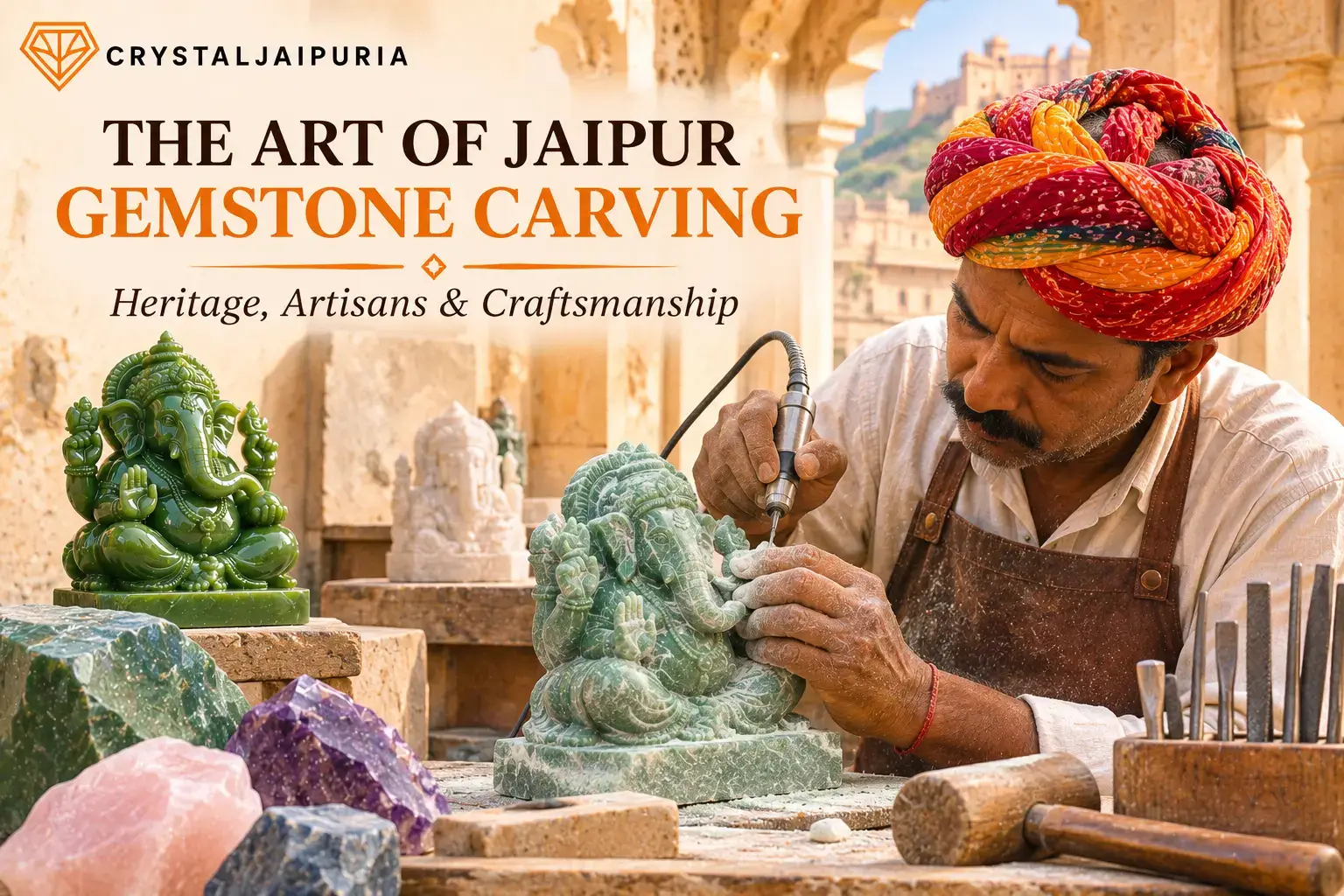
Jaipur, the storied Pink City of Rajasthan, holds an immortal place in the annals of global decorative arts. Beyond its celebrated trade in faceted emeralds and royal jewelry, Jaipur has nurtured a three-century-old tradition of transforming solid earth-mined gemstone boulders into breathtaking sacred deities, royal animal figurines, and intricate decorative masterpieces.
This venerable craft is not mere mechanical stonemasonry; it is an intimate, sacred dialogue between raw geological nature and hereditary human artistry. In Jaipur, master lapidary sculptors (*shilpkars*) spend months interpreting the internal crystal grain, phantom inclusions, and natural color banding of rough stones before striking the first chisel blow.
This guide takes you inside the historic workshops of Jaipur, exploring the raw materials, time-honored lapidary tools, multi-stage sculpting processes, and living heritage that make Jaipur gemstone art a globally treasured tradition.
✨ Heritage Hallmarks of Jaipur Lapidary
- • 300+ Years of Lineage: Founded under Maharaja Sawai Jai Singh II in 1727 with royal artisan guilds.
- • Vedic Shilpa Shastra: Deity sculptures adhere strictly to sacred proportion texts ensuring spiritual resonance.
- • Academic Documentation: Formally documented by IIT Bombay's Industrial Design Centre through the D'Source National Initiative.
- • Living Mastery: Hereditary artisans passing down intuitive stone-reading secrets through generations.
1. Jaipur's Royal Gemstone Heritage
When Maharaja Sawai Jai Singh II founded Jaipur in 1727, he envisioned a planned city of commerce and art. He established specialized artisan quarters—most notably *Johari Bazaar* and *Ghat Gate*—inviting master lapidaries, gem cutters, and enamellers from across the Mughal empire and Persia with land grants and royal tax exemptions.
Educational field research published by IIT Bombay's Industrial Design Centre through the D'Source Initiative meticulously documents Jaipur's stone carving practices, creating an invaluable archive of how traditional skills are applied to diverse geological minerals.
2. Natural Gemstone Materials of the Jaipur Lapidary
Unlike standard soft marble or soapstone, Jaipur lapidary artisans sculpt hard crystalline gemstones requiring diamond tooling:
Clear Quartz (Sphatik) • Mohs 7
Revered in Vedic scriptures for spiritual cooling and light refraction. Used for sacred Shivlings, Shree Yantras, and divine murtis.
Green Jade (Nephrite & Jadeite) • Mohs 6.5
Prized for its fibrous microcrystalline toughness. Allows master sculptors to carve intricate, delicate negative undercuts without chipping.
Rose Quartz & Amethyst • Mohs 7
Pastel pink and regal purple macrocrystalline quartz sculpted into compassionate deities, meditating Buddhas, and luxury animal figures.
Natural Corundum Ruby & Sapphire • Mohs 9
Among the hardest substances known to science. Sculpted using high-torque diamond burs into collector-grade Ganesha and Lakshmi idols.
3. The 6 Progressive Stages of Jaipur Gemstone Carving
The documented Jaipur lapidary journey follows six disciplined operational phases:
Stage 1: Stone Dressing & Flaw Mapping
The raw mineral boulder is water-washed and examined under concentrated light to map internal fractures, colour banding, and cleavage planes.
Stage 2: Sacred Drafting & Iconographic Transfer
The master sculptor sketches the sacred proportions directly onto the stone face adhering to Vedic Shilpa Shastra canons.
Stage 3: Rough Profile Cutting & Massing
Continuous water-cooled diamond circular saws and abrasive grinding discs remove excess outer stone mass to establish the primary anatomical volume.
Stage 4: Precision Micro-Carving & Undercuts
Artisans use flexible-shaft diamond dental burs and miniature specialty chisels to sculpt facial features, crown mukuts, drapery folds, and sacred mudras.
Stage 5: Progressive Emery Smoothing
Abrasive silicon carbide and diamond-coated files remove all tooling ridges, transitioning the surface into a silky satin finish.
Stage 6: Diamond Paste & Velvet Buffing
The sculpture is buffed against wooden and velvet laps charged with micron diamond paste and cerium oxide to unleash a permanent, liquid-mirror gloss.
4. Preserving the Living Tradition at Crystal Jaipuria
Founded in 1989 in Sanganer, Jaipur, Crystal Jaipuria preserves this glorious living heritage. By bringing together generations of hereditary shilpkars under modern ethical workshop conditions, we deliver authentic, certified natural gemstone idols to homes and temples worldwide.
Explore our handcrafted masterpieces directly from Jaipur across our God Statues, Sphatik Shivlings, and Crystal Statues collections.
Own a Handcrafted Piece of Jaipur's Living Heritage
Every Crystal Jaipuria idol is individually sculpted from 100% certified earth-mined natural gemstone in our Sanganer workshop, backed by our authenticity guarantee.
Frequently Asked Questions
1. Why is Jaipur world-renowned for gemstone carving?
Founded in 1727 with royal patronage from Maharaja Sawai Jai Singh II, Jaipur established dedicated quarters for master lapidary guilds. Over three centuries, generational hereditary skills transformed Jaipur into the global epicenter for colored gemstone cutting and idol sculpting.
2. What natural materials are traditionally carved by Jaipur artisans?
Jaipur artisans work with diverse geological varieties: quartz crystals (Sphatik, Rose Quartz, Amethyst, Smokey Quartz), microcrystalline stones (Green Jade, Agate, Chalcedony), metamorphic rocks (Lapis Lazuli), and precious corundum (Ruby and Sapphire).
3. Which traditional and modern tools are used in Jaipur carving workshops?
Artisans utilize tooth chisels, flat chisels, steel hammers, high-speed water-cooled diamond-coated rotary burs, wooden lapidary wheels charged with emery and diamond pastes, and velvet buffing wheels.
4. What are the core stages of gemstone carving in Jaipur?
The process follows six meticulous stages: stone dressing and raw block inspection, design drafting, rough grinding and profile massing, fine anatomical detailing and undercuts, abrasive surface smoothing, and progressive diamond polishing.
5. Are Jaipur gemstone sculptures completely handmade?
High-grade Jaipur carvings utilize a modern hybrid methodology: automated cutting saws handle initial rough blocking to protect mineral integrity, after which master sculptors execute intricate facial features, ornaments, and diamond polishing 100% by hand.
6. Can bespoke deity idols be carved to custom specifications in Jaipur?
Yes. Experienced manufacturers like Crystal Jaipuria in Sanganer, Jaipur offer bespoke commissioned deity idols, Shivlings, and Vastu decor from 2 inches up to monumental 5-foot statement sculptures based on client specifications.