How to Evaluate a Gemstone Carving Supplier: Authenticity, Craftsmanship and Documentation
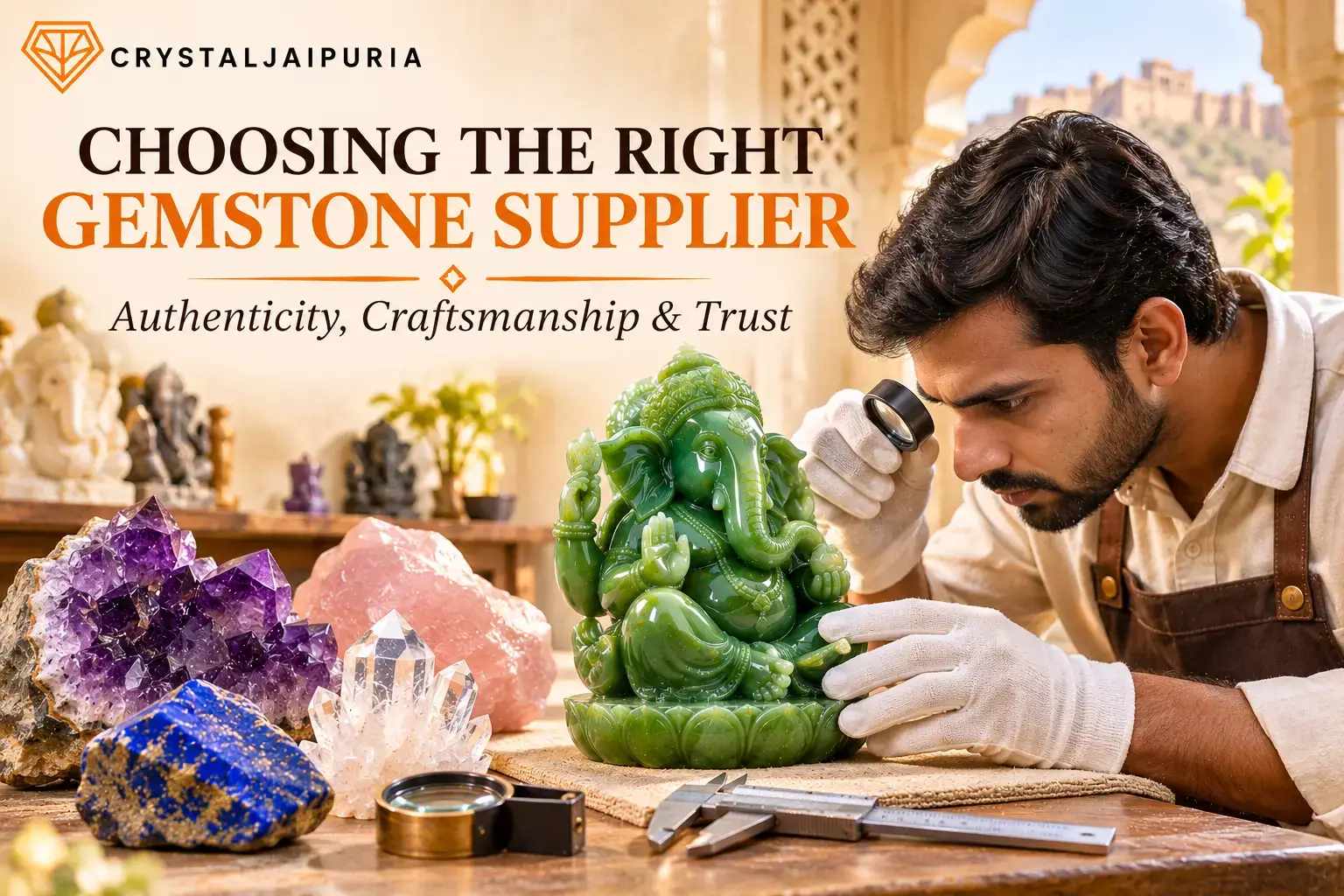
Choosing a gemstone carving supplier is a strategic decision for collectors, retailers, interior designers, and wholesale distributors. A supplier's professional reliability directly influences not only product aesthetics and material transparency, but also order repeatability, export documentation, and transit safety.
A beautifully photographed gemstone sculpture on a digital screen does not automatically guarantee that the delivered piece will match its description. Professional buyers must systematically evaluate the mineral source, lapidary manufacturing process, technical specifications, and supporting laboratory documentation before placing an order.
A dependable supplier provides uncompromised mineral clarity, accurate dimensional metrics, transparent business communication, and rigorous quality standards. This guide provides a structured methodology to assess suppliers and eliminate purchasing risks.
✨ Supplier Evaluation Checklist Summary
- • Role Verification: Identify whether the vendor is an in-house manufacturer, stockist wholesaler, or trading agent.
- • Mineral Transparency: Insist on precise mineralogical variety disclosure (e.g. Jadeite vs Nephrite, Quartz vs Glass).
- • Craftsmanship Inspection: Scrutinize symmetry, anatomical undercuts, facial bhavas, and base stability via video.
- • Sample Benchmarking: Never confirm bulk orders without approving a physical prototype establishing quality boundaries.
1. Verify the Supplier's Business Background & Manufacturing Role
Begin by establishing who you are purchasing from. Manufacturers, wholesalers, and trading intermediaries operate with fundamentally different cost structures and quality safeguards:
Full Workshop Control
Operates own lapidary cutting, carving, and polishing facilities (e.g. Crystal Jaipuria in Sanganer, Jaipur). Can execute custom designs, adjust sizes, and provide factory-direct pricing.
Ready Inventory
Maintains large ready-to-ship warehouses. Ideal for immediate order fulfilment of standard catalog figurines, but limited customisation capability.
Broker Model
Sources goods from external workshops on commission. May offer diverse catalogs but lacks direct oversight over mineral purity and carving timelines.
2. Confirm the Exact Gemstone Mineral & Treatment Status
Mineral identification is the single most critical aspect of gemstone sourcing. Trade names can often be vague or misleading. For instance, commercial "Jade" can mean authentic Nephrite, Jadeite, or inexpensive dyed quartzite or serpentine.
A professional supplier should explicitly document:
- Exact Geological Variety: E.g., Natural Corundum Ruby, Natural Quartz (Sphatik), Natural Lapis Lazuli with Pyrite inclusions.
- Growth Status: 100% Earth-Mined Natural vs Laboratory-Grown / Synthetic.
- Treatment Transparency: Clarify whether the stone has undergone thermal heat treatment, resin impregnation, dyeing, or irradiation.
- Density & Hardness: Verification of specific gravity and Mohs hardness.
3. Scrutinize Gemstone Certification & Documentation
Documentation provides legal and commercial security between buyer and seller. Depending on order volume and unit value, required documentation includes:
Independent Gemological Lab Reports
Look for reports from recognized laboratories (GIA, IGI, or authorized national gem testing laboratories) detailing refractive index, specific gravity, and natural inclusion patterns.
Manufacturer Certificate of Authenticity
Official signed certificate on company letterhead declaring mineral origins, dimensions, weight, and artisan workshop verification.
Commercial Invoices & Harmonized Customs Codes
Accurate HS Code classifications (e.g. Chapter 71 for semi-precious stones and carvings) to ensure seamless customs clearance without regulatory penalties.
4. Supplier Evaluation Factor Matrix
| Evaluation Factor | What to Verify | Red Flags to Watch For |
|---|---|---|
| Business Model | Direct workshop facility, physical address, business credentials | Virtual addresses only; refusal to share live workshop video |
| Material Integrity | 100% natural solid stone; mineral variety disclosure | Vague terms like "crystal stone"; dyed composite resins |
| Documentation | Accredited gem lab reports; formal commercial invoices | Photocopied generic certificates without report numbers |
| Craftsmanship | Anatomical symmetry, crisp undercuts, high mirror buff | Rough tool grooves, dull patches, wobbling bases |
| Capacity & Lead Times | Realistic production schedules; artisan team scale | Unrealistically fast turnaround promises for intricate handwork |
| Packaging & Logistics | Custom foam inserts, ISPM 15 wooden crates, transit insurance | Loose bubble-wrap in standard corrugated cardboard |
5. Why Jaipur Is the Epicenter for Gemstone Carving
For over 300 years, Jaipur, Rajasthan has remained the world's most distinguished hub for colored gemstone processing, cutting, and lapidary sculpting. Field documentation published by IIT Bombay's Industrial Design Centre through the D'Source Initiative records Jaipur's traditional artisan guilds, detailing their time-honored methods of raw crystal selection, hand drafting, and emery wheel polishing.
Sourcing directly from Jaipur gives global retailers and discerning collectors direct access to generations of hereditary artisan mastery. Established in 1989 in Sanganer, Jaipur, Crystal Jaipuria combines this venerated lapidary lineage with modern export logistics and strict gemological verification across our Crystal Statues and God Statues collections.
Connect Directly with Jaipur's Master Gemstone Artisans
Looking for certified natural gemstone statues or seeking a reliable manufacturing partner for custom retail collections? Consult our expert team in Jaipur.
Frequently Asked Questions
1. How do I know if a gemstone supplier is genuine?
Check business registration details, workshop address, product specifications, material disclosures, available gemological documentation, transparent communication, and actual physical product quality. Request video walkthroughs of the workshop facility.
2. Should I always ask for a gemstone certificate?
Yes, for valuable carvings. Ensure the report is issued by a recognized gemological laboratory (such as GIA, IGI, or a government-accredited testing lab) and that it explicitly covers the exact specimen rather than serving as a generic batch photocopy.
3. Is a direct gemstone manufacturer better than a trader?
A direct manufacturer offers lower factory pricing, direct control over design changes, bespoke sizing flexibility, and authentic material oversight. A trader may offer multi-category catalogs but often lacks deep lapidary quality control.
4. Should I order a sample before placing a wholesale order?
Always. An approved sample establishes the physical benchmark for mineral quality, carving proportions, dimensional accuracy, surface polish, and packaging standards before committing to volume production.
5. What should a comprehensive gemstone supplier quotation include?
A professional quotation should specify the exact mineral variety, dimensions, weight range, unit price, custom tooling fees, export packaging specifications, delivery terms (Incoterms), and laboratory testing documentation.