Hand-Carved vs Machine-Made Stone Decor: Craftsmanship, Finish and Quality
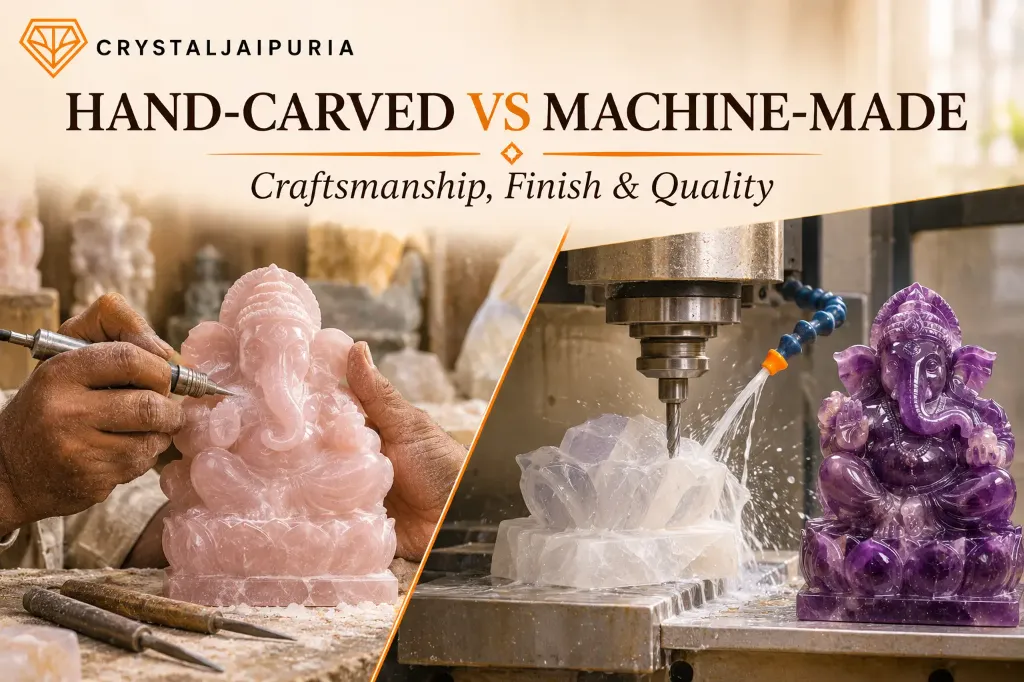
Stone décor products are created using a spectrum of carving and manufacturing techniques. While some pieces require hundreds of hours of painstaking manual craftsmanship by master artisans, others utilize sophisticated computer-controlled machinery for cutting, shaping, profiling, and polishing.
Both approaches are capable of producing visually striking decorative objects and sacred artifacts. However, they differ substantially in design flexibility, dimensional repeatability, anatomical detailing, production speed, and labour requirements.
The fundamental difference between hand-carved and machine-made stone décor lies in the level and type of human involvement during the sculpting journey. Today, modern lapidary studios in Jaipur frequently combine both methods—harnessing the speed and precision of machinery for rough blocking while relying on artisan mastery for expressive detailing and surface finishing. Understanding these methodologies empowers collectors and interior designers to evaluate gemstone figurines and stone sculptures with discernment.
✨ Core Comparison Takeaways
- • Artisan Adaptability: Hand carving allows sculptors to read natural crystal grain, adjust for mineral inclusions, and sculpt expressive facial contours.
- • Machine Precision: Automated equipment achieves exact dimensional repeatability and efficient batch production for geometric designs.
- • The Hybrid Reality: High-end gemstone sculptures frequently employ machine-assisted initial blocking followed by manual carving and diamond hand-polishing.
- • Holistic Evaluation: Finished artistic symmetry, surface polish uniformity, and certified gemstone authenticity matter far more than simplistic marketing claims.
1. What Is Hand-Carved Stone Décor?
Hand-carved stone décor refers to artifacts shaped through manual craftsmanship using tools directed entirely by skilled human artisans. Depending on the material hardness and design complexity, these tools range from traditional steel chisels, hammers, and wooden laps to specialized rotary diamond burrs, abrasives, and hand-held flexible shafts.
The sculptor works subtractively, gradually removing material layer by layer to unveil the required form, anatomical proportions, and delicate surface details. For intricate sacred idols and gemstone sculptures, the master carving process encompasses seven deliberate phases:
Geological Examination
Studying the rough crystal's natural grain, cleavage lines, colour zoning, and internal veil inclusions.
Iconographic Layout
Marking reference coordinates and Shilpa Shastra proportions directly onto the stone face.
Rough Chipping & Massing
Carefully knocking away peripheral waste rock to isolate the primary anatomical volume.
Establishing Primary Form
Carving torso, limbs, crown, and pedestal with careful spatial balance.
Intricate Detailing & Undercuts
Sculpting facial features, eyes, jewelry ornaments, drapery folds, and negative spaces.
Smoothing & Diamond Polish
Refining surfaces with emery grits, followed by multi-stage diamond paste buffing for brilliant lustre.
Hand carving grants the artisan unmatched adaptability during production. If an unexpected colour vein or natural fissure appears within the mineral during carving, the sculptor can dynamically alter the posture, drapery angle, or ornament placement to incorporate or bypass the feature safely.
2. What Is Machine-Made Stone Décor?
Machine-made stone décor utilizes powered mechanical and automated equipment to execute some or all material-removal and shaping operations. In contemporary production facilities, machinery commonly includes:
- Diamond Bridge Saws: Heavy circular blades that cut large raw boulder blocks into rectilinear slabs with micron precision.
- Automated Grinding Wheels: Profile-shaping abrasive discs used for rough cylindrical or flat geometric outlines.
- Rotary & Ultrasonic Tools: High-frequency vibratory tools that carve intricate relief impressions without exerting mechanical stress on fragile stones.
- Multi-Axis CNC Carving Routers: Computer Numerical Control routers capable of tracing 3D CAD digital models directly into stone blocks.
- Mechanical Tumbling & Vibratory Polishers: Bulk polishing vessels that tumble small stone objects in abrasive slurries to achieve uniform gloss.
Machinery excels at achieving uniform dimensions, identical proportions, and rapid repeatability when manufacturing series of decorative items or architectural medallions. However, machine-made production does not mean human expertise is eliminated. Skilled operators must still prepare 3D CAD blueprints, calibrate spindle feed rates according to mineral hardness, align rough blocks, and perform post-machining inspection.
3. Hand-Carved vs Machine-Made: Key Differences Comparison Table
Neither method is universally superior; each satisfies specific aesthetic, architectural, and production needs. The table below illustrates how the two approaches compare across core parameters:
| Factor | Hand-Carved Stone Décor | Machine-Made Stone Décor |
|---|---|---|
| Main Process | Manual shaping, progressive chiselling, and hand abrasive detailing | Equipment-assisted, CNC router milling, or automated profilometry |
| Human Involvement | Direct, continuous master artisan craftsmanship at every stage | CAD design preparation, machine setup, tooling oversight, and manual finishing |
| Design Flexibility | Dynamic; artisan instantly adapts to unexpected inclusions and crystal grain | Rigidly governed by programmed 3D path; cannot adapt to hidden interior flaws |
| Consistency & Repeatability | Individual artistic variations occur; every finished creation is unique | High dimensional consistency across large multi-piece batches |
| Production Speed | Time-intensive (days to months depending on sculpture scale and hardness) | Rapid and highly efficient for standard repeatable geometric operations |
| Fine Detailing & Undercuts | Deep negative spaces, intricate jewellery undercuts, and expressive facial eyes | Constrained by machine tool axis angles; deep undercuts often require hand touch-up |
| Production Volume | Best for one-of-a-kind heirlooms, sacred temple murtis, and bespoke art | Ideal for high-volume commercial architectural runs and standardized items |
| Surface Finish Quality | Soft, organic curves with deep mirror shine even in tight recesses | Smooth on flat surfaces; step marks or tool paths may require manual buffering |
4. How Hand Carving Creates Individual Character & Artistic Soul
Natural earth-mined gemstones are not uniform synthetic slabs. A single block of natural emerald rough, multi-coloured tourmaline, or banded agate exhibits variegated colour saturation, phantom crystal ghosts, and distinctive veining patterns.
A master artisan utilizes these natural traits to elevate the piece:
- Strategic Colour Placement: An artisan can orient a green inclusion in ruby-in-zoisite so that it becomes the ornate crown or lotus pedestal of a Ganesha carving, transforming an inclusion into an artistic triumph.
- Expression & Bhava: In sacred deity sculpture, capturing the compassionate, divine expression (*bhava*) of Lakshmi or the tranquil meditation of Shiva requires micro-millimetre manual carving of the eyes and lips that rigid digital tooling cannot replicate.
- Natural Organic Transitions: Hand-carved drapery and flowing hair cascade with natural fluidity, avoiding the rigid, sterile geometry typical of pure automated milling.
5. How Machinery Supports Modern Stone Carving
Rather than replacing artisans, modern stone workshops integrate machinery to eliminate strenuous, low-skill physical toil. Heavy stone saws safely slice raw multi-ton boulder blocks into workable segments without micro-fracturing the stone through blunt hammer blows.
Automated grinding discs can remove 70% of redundant outer stone mass within hours—a task that previously took days of manual chisel labour. By delegating rough massing to machines, artisans can dedicate their full creative focus and energy to intricate anatomical detailing, ornate jewellery engraving, and mirror polishing.
6. Why Many Stone Products Use Both Methods: The 6-Stage Hybrid Workflow
In high-end lapidary centers like Jaipur, the finest gemstone statues and décor pieces are produced through a collaborative hybrid workflow that maximizes both machine efficiency and manual artistry:
Stage 1: Material Preparation
Diamond circular saws slice boulder rough into balanced blocks aligned with the stone's optical axis.
Stage 2: Rough Profile Shaping
Grinding wheels or CNC routers carve the basic silhouette and principal spatial masses.
Stage 3: Artisan Detailing & Sculpting
Master sculptors manually carve facial expressions, crown ornaments, undercuts, and symbolic mudras.
Stage 4: Progressive Abrasive Refinement
Successively finer silicon carbide and diamond abrasive papers eliminate machining ridges and chisel marks.
Stage 5: Hand Polishing to High Gloss
Artisans use felt buffs and cerium/diamond oxide slurries to achieve a flawless, reflective glass-like polish.
Stage 6: Multi-Angle Quality Inspection
Final audit examining anatomical symmetry, absence of fractures, base flatness, and gemological authenticity.
A creation developed through this process is accurately described as artisan hand-finished with machine-assisted preparation. Ethical sellers avoid labeling such products as "100% hand-carved from start to finish" when mechanical preparation was employed.
7. How to Evaluate the Quality of a Carved Stone Product
When evaluating decorative stone carvings or sacred idols, evaluate the physical piece using these six criteria:
1. Design & Proportions
Ensure the piece looks visually stable and balanced. In deity sculptures, check whether arm proportions, crown height, and posture adhere to traditional iconography.
2. Surface Finishing Transitions
Inspect the transition between curved and recessed zones. A high-quality piece exhibits continuous, uniform polish without dull grey abrasive patches or circular tooling scratches.
3. Detail Execution
Scrutinize intricate areas: eyes, fingernails, jewellery beads, and fabric fringes. Master craftsmanship displays sharp, crisp definition rather than blunted, rounded-off contours.
4. Bilateral Symmetry
For symmetrical designs (such as Sphatik Shivlings or meditating figures), compare left and right profiles to confirm harmonious balance without unintended tilt.
5. Structural Integrity
Examine thin projections, fingers, and halos for internal shock cracks or glued repairs. The bottom pedestal must sit completely flush and level on a flat surface.
6. Certified Material Authenticity
Verify whether the carving is fashioned from solid, genuine natural earth-mined gemstone rather than bonded stone powder, glass, or dyed synthetic resin.
8. Which Method Excels for Intricate Gemstone Sculptures?
The ideal carving method depends intimately on the mineral's physical characteristics. Precious and semi-precious gemstones possess varying crystal systems, Mohs hardness ratings, and cleavage tendencies:
- Fibrous & Tough Stones (Jade, Chalcedony, Agate): Highly resistant to fracturing under vibration. Machines can sculpt complex reliefs reliably, while artisans carve intricate openwork loops and interlocking rings.
- Crystalline & Cleavable Stones (Quartz, Amethyst, Tourmaline, Emerald): Possess internal stress fractures and distinct cleavage planes. Excessive machine router heat or high-speed vibration can shatter the entire block. Such minerals require the gentle, responsive touch of an artisan operating variable-speed water-cooled diamond burs.
9. Essential Questions Buyers & Wholesale Clients Should Ask Manufacturers
Before commissioning a bespoke deity statue or ordering wholesale collections, ask the supplier:
- 1. Which production stages are performed manually and which use automated machinery?
- 2. Is the final facial detailing and surface polishing completed by master artisans?
- 3. What exact geological mineral variety is used, and can gemological lab certification be provided?
- 4. What degree of dimensional and colour variation should be anticipated across pieces?
- 5. Can multi-angle high-resolution photographs or video walkthroughs of the exact piece be shared before dispatch?
- 6. What transit packaging protocols (shockproof foam, wooden boxing) are used to prevent transit fracture?
10. Jaipur's World-Renowned Gemstone Carving Heritage
For over three centuries, Jaipur, Rajasthan has stood as the global epicenter of colored gemstone cutting and lapidary sculpture. Supported by royal patronage since the reign of Maharaja Sawai Jai Singh II, generations of master stonecutters (*shilpkars*) have perfected the art of translating raw earth-mined quartz, jade, ruby, and lapis into breathtaking sacred icons.
Academic field documentation published by IIT Bombay's Industrial Design Centre through the D'Source National Design Innovation Initiative meticulously records Jaipur's traditional lapidary methods—demonstrating how sculptors sketch geometries directly onto stone slabs, execute diamond wheel roughing, perform specialized miniature carving, and buff surfaces with corundum-wood laps.
This living heritage proves that gemstone carving transcends mechanical cutting; it represents an intimate dialogue between geological nature and human artistry. Today, Crystal Jaipuria preserves this venerable tradition, offering discerning collectors worldwide access to masterfully sculpted collections across our Crystal Statues and God Statues galleries.
Explore Artisanal Gemstone Décor & Custom Statues
Looking for a custom-carved deity idol or statement stone sculpture tailored to your precise space? Consult with our master lapidary sculptors in Jaipur for bespoke commissions.
Frequently Asked Questions
1. Is hand-carved stone décor always better than machine-made décor?
No. Actual quality depends on the raw mineral grade, design complexity, workmanship, and finishing standards. A poorly executed hand carving with visible fractures is inferior to a precision machine-cut piece, whereas a master artisan hand carving possesses unique expressive character and nuance that machinery cannot duplicate.
2. Can machines create intricate, detailed gemstone sculptures?
Yes. Advanced multi-axis CNC routers and ultrasonic carving machines can carve complex geometries, repeatable relief patterns, and precise dimensions. However, delicate anatomical undercuts, facial bhavas, and micro-polishing in hard-to-reach recesses still require skilled artisan handwork.
3. Are handmade gemstone sculptures identical across units?
Not necessarily. Individual pieces can vary due to natural material characteristics and manual production methods. Natural earth-mined stones have unique crystal structures, colour banding, and internal inclusions, ensuring that every handcrafted statue is inherently one of a kind.
4. What is machine-assisted stone carving?
Machine-assisted carving combines specialized equipment for primary block cutting and rough bulk shaping with human artisan involvement in design, anatomical detailing, undercut refinement, and progressive multi-stage polishing.
5. How can I identify a hand-finished stone sculpture?
Ask the manufacturer about their production process and inspect surface transitions, fine curves, and recessed corners. Hand-finished pieces display subtle artisan tool marks, natural organic flowing curves, and meticulous polish even within deep drapery folds that standard mechanical tools cannot reach.
6. Which carving method is suitable for wholesale production?
The suitable method depends on order volume, design complexity, mineral hardness, consistency requirements, and production lead times. Machine-assisted roughing with artisan hand-finishing is generally the optimal solution for commercial and wholesale orders requiring both scale and fine aesthetics.