How Gemstone Carving Works: From Raw Crystal to Finished Sculpture
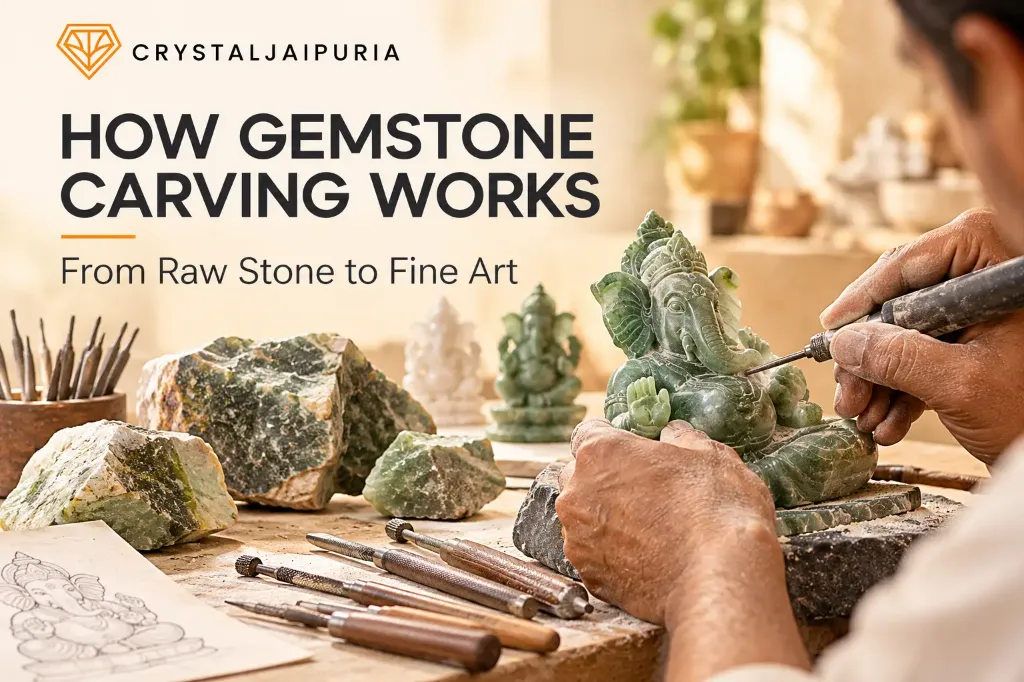
Gemstone carving is the intricate process of shaping natural or synthetic gem materials into decorative objects, sacred sculptures and intricate designs. It combines geological material knowledge, rigorous design planning, specialised lapidary tools and meticulous finishing.
The journey begins with selecting a suitable rough stone and continues through cutting, shaping, detailing, surface grinding, polishing and comprehensive quality inspection. Each stage directly influences the final sculpture's aesthetic beauty, durability and level of detail.
For gemstone statues and crystal décor, the primary artisan challenge is to create a well-proportioned, sacred design while respecting the raw crystal's natural geological characteristics.
🏛️ Jaipur Lapidary Heritage Since 1989
At Crystal Jaipuria, our master artisans in Sanganer, Jaipur combine generational lapidary skills with ancient Shilpa Shastra canons. Learn how rough gemstones from around the world are sculpted into sacred deity idols and collector masterpieces.
1. Selecting the Right Gemstone
The first step is choosing a raw stone that suits the intended design. Master artisans carefully evaluate the gemstone variety, colour saturation, physical dimensions, transparency, internal crystal structure and visible fractures.
Different mineral materials behave uniquely during carving. Quartz varieties (Clear Sphatik Quartz, Rose Quartz, Amethyst), Jade varieties, Lapis Lazuli, and Aventurine have distinct physical cleavage planes and visual characteristics. The correct approach depends on the specific stone rather than applying a single rigid technique to every mineral.
A large idol or temple sculpture requires a solid, dense block with sufficient structural integrity and thickness. Conversely, a delicate figurine or mudra hand gesture demands material that can support delicate features without excessive micro-breakage.
Natural colour variations also inspire the design. An artisan may deliberately plan a carving around a distinctive vein, inclusion, or golden rutile needle rather than treating every part of the rough stone as visually identical.
2. Planning the Design & Proportions
Once a suitable mineral block is selected, the artisan determines how the design will fit harmoniously within the available raw material.
Planning involves technical sketches, reference iconography, precise calipers measurements, or physical wax modeling. For figurines and sacred deity sculptures (such as Ganesha Idols or Buddha statues), the artisan must consider divine proportions, symmetry, depth, and the exact placement of fine features.
The design stage also minimises unnecessary material removal. Unlike clay or bronze casting, a gemstone carving is a purely subtractive art—a gemstone cannot easily be rebuilt if a major section is accidentally cut away.
For complex sculptures, planning the position of the head, limbs, crown (mukut), ornaments, pedestal base, and decorative elements is vital. Structural stability remains a paramount priority throughout the layout.
3. Cutting the Rough Stone (Slabbing & Blocking)
The raw gemstone is prepared by removing weathered rind sections, matrix rock, and unsuitable fracture zones to create a workable sculpture blank. Artisans employ diamond-impregnated circular saws, wire saws, and abrasive cutting equipment.
Cutting requires immense control because internal stress fractures can cause unexpected fracturing under mechanical pressure. The objective is to establish the approximate spatial envelope while preserving enough stone for later detailing.
Continuous water cooling is applied during cutting to manage frictional heat, prevent thermal shock cracks in heat-sensitive crystals like Amethyst, and suppress airborne mineral dust for a safe workshop environment.
4. Rough Shaping and Sculpting
After cutting, the stone blank is gradually sculpted into the main physical form of the sculpture.
Coarse diamond abrasives, rotary burrs, and handheld shaping wheels remove bulk material to establish the silhouette, three-dimensional proportions, and major contours. The lapidary master works progressively, rotating the piece and checking the form from all angles under directional light.
The aim at this stage is not to achieve the finished surface immediately. Rough shaping establishes the structural foundation while leaving sufficient margin for fine refinement and detailed carving.
5. Adding Intricate Details
Detailing gives a gemstone sculpture its distinctive soul and character. Depending on the design, this phase involves sculpting facial features, graceful drapery folds, intricate jewelry, mudras, textured hair, or fine sacred symbols.
Miniature dental-grade rotary diamond points, micro-chisels, and specialized burrs allow controlled, microscopic material removal. The artisan must balance aesthetic detail with the natural tensile strength of the mineral.
Thin projections, delicate fingers, and sharp edges are inherently vulnerable to chipping. A master carver navigates these vulnerabilities by orienting fine features along the mineral's strongest crystal axes.
6. Grinding and Surface Refinement
Once the sculptural details are carved, the stone's surface is refined using progressively finer diamond grits (from 220 grit down to 1200 and 3000 grit).
Grinding eliminates coarse tool marks, smooths anatomical transitions, and prepares the crystalline lattice for high-sheen polishing. Skipping grits or using unsuitable abrasives leaves noticeable subsurface scratches that ruin the final luster.
The artisan inspects curved surfaces, recessed crevices, and undercuts under magnification to ensure absolute textural consistency across all 360 degrees of the sculpture.
7. Polishing the Gemstone
Polishing is the transformative stage that unlocks the gemstone's optical brilliance, transparency, and rich natural colour saturation.
Different mineral species require specific polishing laps and chemical compounds:
- Cerium Oxide: The premier polishing compound for Quartz, Sphatik, Rose Quartz, and Agates, yielding a glass-like vitreous luster.
- Diamond Paste (0.5 to 1 micron): Used for harder corundum varieties, Jade, and dense mineral sculptures.
- Tin Oxide & Aluminum Oxide: Excellent for softer decorative minerals, producing an elegant, satin-like sheen.
Polishing does not make every stone transparent or erase internal inclusions. Rather, a high-quality finish accentuates the natural character, colour zoning, and sacred veiling of the genuine earth crystal.
8. Final Inspection and Quality Checks
Before any sculpture is approved for dispatch, it undergoes rigorous lapidary inspection:
- Structural Proportions: Confirming overall balance, facial symmetry, and base stability.
- Feature Integrity: Checking fine edges, mudra fingers, and ornaments for micro-chips.
- Surface Finish: Inspecting all facets under directional lighting for scratches or dull spots.
- Physical Specifications: Confirming precise weight in grams/kilograms and dimensions in inches/centimeters.
- Safe Export Packaging: Custom foam lining, shock-absorbent cushioning, and heavy-duty wooden crating.
Why Gemstone Carving Requires Specialised Skills
Unlike wood, marble, or metal, gemstone carving demands acute mineralogical intuition. Crystals have directional hardness, cleavage planes, and natural internal tensions that dictate how the tool must interact with the stone.
Jaipur artisans train for over a decade to master the delicate interplay between tool speed, water flow, pressure, and crystal acoustics—recognizing instinctively when a mineral fracture requires design adaptation to preserve structural integrity.
How to Evaluate a Finished Gemstone Sculpture
When evaluating a gemstone sculpture, look beyond mere surface shine:
- Symmetry & Expression: In deity idols, observe the calmness of the face (saumya mudra) and balanced anatomy.
- Base Stability: The sculpture should rest securely on a flat surface without wobbling.
- Depth of Undercuts: Master carvers create deep, crisp undercuts around crowns, drapery, and ornaments rather than shallow surface scratches.
- Material Certification: Review the independent gemological laboratory test report to confirm genuine, untreated natural origin.
Explore Authentic Handcrafted Statues
Crystal Jaipuria presents its gemstone carvings as timeless works shaped through centuries-old Jaipur craftsmanship. Explore our Crystal Statues Collection and God Statues Collection to review individual specifications and find the perfect sacred sculpture.
Conclusion
Gemstone carving combines careful material selection, rigorous design planning, controlled subtractive shaping and meticulous finishing. Each stage contributes fundamentally to the final sculpture's aesthetic beauty and longevity.
Understanding the process empowers buyers to appreciate true artisanal craftsmanship, ask pertinent questions and evaluate finished carvings with confidence. For valuable pieces, always combine visual inspection with clear material disclosures and authentic documentation.
Frequently Asked Questions
1. What is gemstone carving?
Gemstone carving is the process of shaping a gem material into a sculpture or decorative object using cutting, grinding, detailing and polishing techniques.
2. Which tools are used for gemstone carving?
Depending on the material and design, artisans may use saws, rotary tools, diamond abrasives, grinding equipment and polishing tools.
3. How long does gemstone carving take?
The time varies with the stone's hardness, size, design complexity, level of detail and finishing requirements. There is no universal production time.
4. Can natural inclusions affect a carving?
Yes. Inclusions and fractures can influence material selection, design planning and the durability of delicate features.
5. What makes a gemstone sculpture well finished?
Consistent polishing, balanced proportions, precise details, stable construction and conformity with the stated specifications are important indicators of workmanship.