What Determines the Price of a Natural Gemstone Carving? A Buyer's Guide
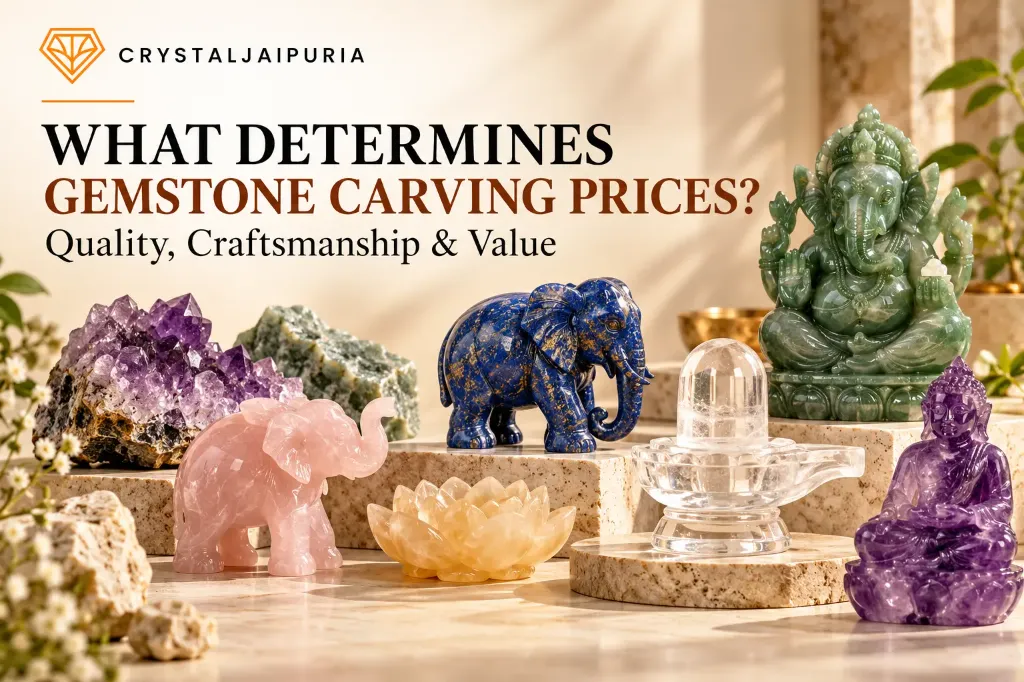
The commercial and artistic value of a natural gemstone carving is determined by a synthesis of geological rarity, material quality, physical dimensions, sculptural complexity and master artisanship. Independent gemological certification, custom packaging, and export logistics also contribute to the final price.
Two sculptures of comparable physical dimensions can exhibit vastly different prices. One might be sculpted from high-grade, gem-clarity Clear Sphatik Quartz requiring weeks of microscopic hand-detailing, while another utilizes a commercially abundant mineral with simple geometric outlines.
Understanding these transparent valuation parameters helps collectors, temple trustees, and wholesale buyers compare quotations accurately and verify that a price reflects authentic material value and master workmanship.
⚖️ The Core Valuation Formula
Total Value = Raw Mineral Quality & Weight + Artisanal Labour & Carving Hours + Lapidary Finishing + Documentation & Export Logistics. Transparent material disclosure is the foundation of genuine value.
1. The Type and Geological Rarity of Gemstone
The mineral species is the foremost baseline driver of cost. Rare earth minerals with limited geological deposits naturally command higher raw rough per-kilogram prices.
For instance, genuine deep-blue Lapis Lazuli (Badakhshan origin) or natural Australian Jade commands a significantly higher raw material cost than common white quartz or aventurine. Even within the same mineral family (e.g. Quartz), natural optical-grade water-clear Sphatik costs multiples of semi-opaque milky quartz.
A reliable comparison always starts with mineral identification rather than visual color alone. Buyers should confirm whether a stone is 100% natural earth-mined, lab-created synthetic, or imitation glass before comparing prices.
2. Weight, Physical Dimensions & Stone Yield
Carvings are frequently priced on weight (grams, kilograms, or carats) combined with volumetric dimensions (height, width, depth).
Larger sculptures require massive monolithic raw crystals. In nature, finding a flawless, crack-free 10-kilogram rough crystal of Rose Quartz or Amethyst is exponentially rarer than finding ten 1-kilogram pieces. As size increases, raw material cost scales non-linearly.
Furthermore, gemstone carving produces high material waste (yield loss). Sculpting a complex 3-kilogram deity statue often requires cutting away 5 to 8 kilograms of rough stone. The cost of that discarded rough material must be absorbed into the finished sculpture's price.
3. Natural Stone Quality, Colour Saturation & Inclusions
Within any specific gemstone type, individual specimens vary across four critical mineral parameters:
- Colour Purity & Richness: Vivid, rich royal blues in Lapis Lazuli or deep lavender purples in Amethyst command top valuations.
- Transparency & Optical Clarity: Transparent, water-clear Sphatik Quartz with minimal internal fractures represents the pinnacle of Vedic valuation.
- Structural Integrity: Stones free from penetrating cracks and unstable cleavage planes ensure the carving will endure for generations without structural failure.
4. Design Complexity and Artisanal Carving Time
A simple smooth sphere or polished egg may take an artisan 1 to 2 days to shape and polish. In contrast, an intricate multi-armed Ganesha, Nataraja, or Radha Krishna sculpture requires 3 to 6 weeks of meticulous, patient carving by a senior Jaipur master sculptor.
Factors increasing labor time and technical difficulty include:
- Deep Undercuts & Pierced Openwork: Carving through stone to create hollows behind limbs and ornaments.
- Delicate Projections: Mudra hands, weapons, flutes, and crown spires with high breakage risk during rotary grinding.
- Micro-Facial Detailing: Achieving divine facial expressions (saumya bhava) as prescribed in ancient Shilpa Shastra treatises.
5. Hand-Finishing and Overall Craftsmanship
Finishing separates commercial-grade factory souvenirs from heirloom collector sculptures:
- Consistency of Polish: Uniform high vitreous luster reaching into all deep folds, recessed crevices, and undercuts.
- Symmetry and Anatomical Grace: Perfectly balanced deity postures and authentic Vedic proportions.
- Base Stability: A precisely ground, level base allowing the sculpture to stand firmly without wobble.
- Absence of Micro-Fractures: Smooth, pristine surfaces free from tool chatter marks or abrasive burnishing scars.
6. Certification and Gemological Laboratory Documentation
Reputable gemstone statues are accompanied by independent gemological test certificates verifying refractive index, specific gravity, and 100% natural earth-mined origin.
A laboratory report provides legal verification for high-value temple investments and export clearance. While certification adds a nominal documentation fee, it protects buyers against synthetic and treated imitations.
7. Customisation and Decorative Metalwork
Custom commission requests—such as bespoke deity postures, customized bases, or inlaid precious metalwork (pure silver crowns, 24K gold foil detailing)—involve specialized goldsmith labor and separate material costs.
8. Packaging, Insurance, Shipping and Order Quantity
Heavy or fragile gemstone sculptures require specialized multi-layer packaging: custom-cut high-density foam, waterproof wraps, shock-absorbing cushions, and fumigated export wooden crates.
For wholesale and B2B temple export shipments to the USA, UK, Canada, Australia, and the UAE, insured door-to-door express transit ensures zero-damage delivery. Direct factory wholesale suppliers like Crystal Jaipuria offer tiered volume pricing for retail partners and temples.
9. How to Compare Gemstone Carving Quotations
When evaluating quotations from different suppliers, compare like-for-like parameters using this checklist:
| Quotation Factor | What to Verify |
|---|---|
| Material Authenticity | Exact mineral variety, natural vs synthetic origin, known treatments |
| Size & Weight | Net stone weight in grams/kg and exact measured height/width/depth |
| Design Detailing | Carving complexity, depth of undercuts, facial expression precision |
| Surface Finish | Mirror lapidary polish vs rough tumbling, 360-degree consistency |
| Documentation | Independent gemological lab test report included |
| Protective Packaging | Reinforced wooden crating designed for fragile mineral transit |
| Delivery & Insurance | Full transit insurance, doorstep delivery, customs clearance |
| Return Terms | Clear transit damage guarantees and specification compliance |
Direct Manufacturer Pricing from Jaipur
By eliminating intermediaries and operating our own carving workshop in Sanganer, Jaipur, Crystal Jaipuria supplies certified natural gemstone carvings directly to temples, retailers, and devotees at authentic factory rates. Explore our Crystal Statues Collection and God Statues Collection.
Conclusion
The price of a natural gemstone carving reflects a combination of mineral rarity, usable crystal yield, design complexity, artisanal labor and secure delivery requirements. Understanding these factors makes it easy to compare quotations and identify true value.
Before purchasing, confirm the gemstone variety, verified specifications, polish quality, laboratory documentation and total delivered cost. For custom or wholesale orders, written specifications and sample approval guarantee complete satisfaction.
Frequently Asked Questions
1. What is the biggest factor affecting gemstone carving prices?
Material, size, stone quality and craftsmanship are major factors. Their relative importance depends on the individual carving.
2. Does a heavier gemstone carving always cost more?
Not necessarily. Weight influences material requirements, but design complexity, stone quality and finishing work can also have a substantial effect.
3. Why do two carvings made from the same gemstone have different prices?
They may differ in dimensions, colour quality, internal structure, design complexity, labour requirements and finishing.
4. Does a gemstone certificate guarantee the quality of a carving?
Not by itself. A certificate may verify specific material characteristics, but workmanship, dimensions, finish and overall condition require separate evaluation.
5. What should wholesale buyers include in a quotation request?
Specify the gemstone variety, dimensions, weight range, design, quantity, documentation, packaging, delivery destination and required timeline.